
HEIDELBERG MATERIALS: Project Progress Positions Heidelberg Materials as Powerful Global Innovator

From Brevik in Norway to Lengfurt in Germany and Padeswood in the UK, international industry leader in construction resources, Heidelberg Materials is advancing several CCUS Carbon Capture, Utilisation, and Storage (CCUS) projects quickly. The ROI is already becoming clear as CO2 emissions are captured, technology is improved, and new revenue streams are created.
Supported by:
For an industry that quite literally underpins modern life, change has often come slowly. Cement and concrete remain essential to infrastructure, urbanisation, and economic growth, yet they are also responsible for a significant share of global carbon emissions. As policymakers, investors, and customers demand measurable progress towards net-zero, the pressure on producers to innovate has intensified. Against this backdrop, Heidelberg Materials is positioning itself not just as a participant in the transition, but as a frontrunner shaping its direction.
The company, one of the world’s largest manufacturers of cement, aggregates, and ready-mix concrete, operates at a scale where incremental improvements are no longer enough. Instead, it is pursuing structural change, embedding decarbonisation at the heart of its strategy. Central to this is carbon capture, utilisation, and storage, or CCUS – a technology increasingly recognised as indispensable for hard-to-abate sectors where emissions are inherent to production processes.
The drive behind Heidelberg Materials’ decarbonisation push is a group-wide journey because international frameworks are increasingly clear that emission reductions must accelerate across heavy industry to meet global climate goals. Reports from the United Nations Economic Commission for Europe have underscored that rapid deployment of CCUS is essential if net-zero ambitions under the Paris Agreement and the UN Sustainable Development Goals are to be met, particularly in sectors such as cement production where residual emissions are unavoidable without new technology.
CCUS, while a relatively new concept at scale, has been proven. Heidelberg Materials has aligned its strategy with shared global targets, committing to ambitious CO₂ reduction pathways and investing in technologies that can bridge the gap between current performance and future climate commitments.
As Dr. Christian Preuss, Group Lead CCUS, explains, the company’s ambition is both broad and urgent. “We are a global producer of building materials. Our streams of business include cement, aggregates and concrete, and in certain geographies we also have asphalt and pre-cast. It’s everything a construction site could need, and we are one of the leading players globally. We are leading the industry transformation with decarbonisation: We were the first to bring online a carbon capture plant at our site in Brevik, Norway and have already taken FID on our follow-up CCS project in Padeswood, UK, as part of the HyNet North West cluster. These projects are shining examples of what is possible, and we are very proud of the work happening there.”
This emphasis on execution, rather than ambition alone, is evident across Heidelberg Materials’ portfolio of CCUS projects and initiatives. From Norway to the UK, to Germany, the company is implementing a network of CCUS facilities that reflect both local realities and global relevance.
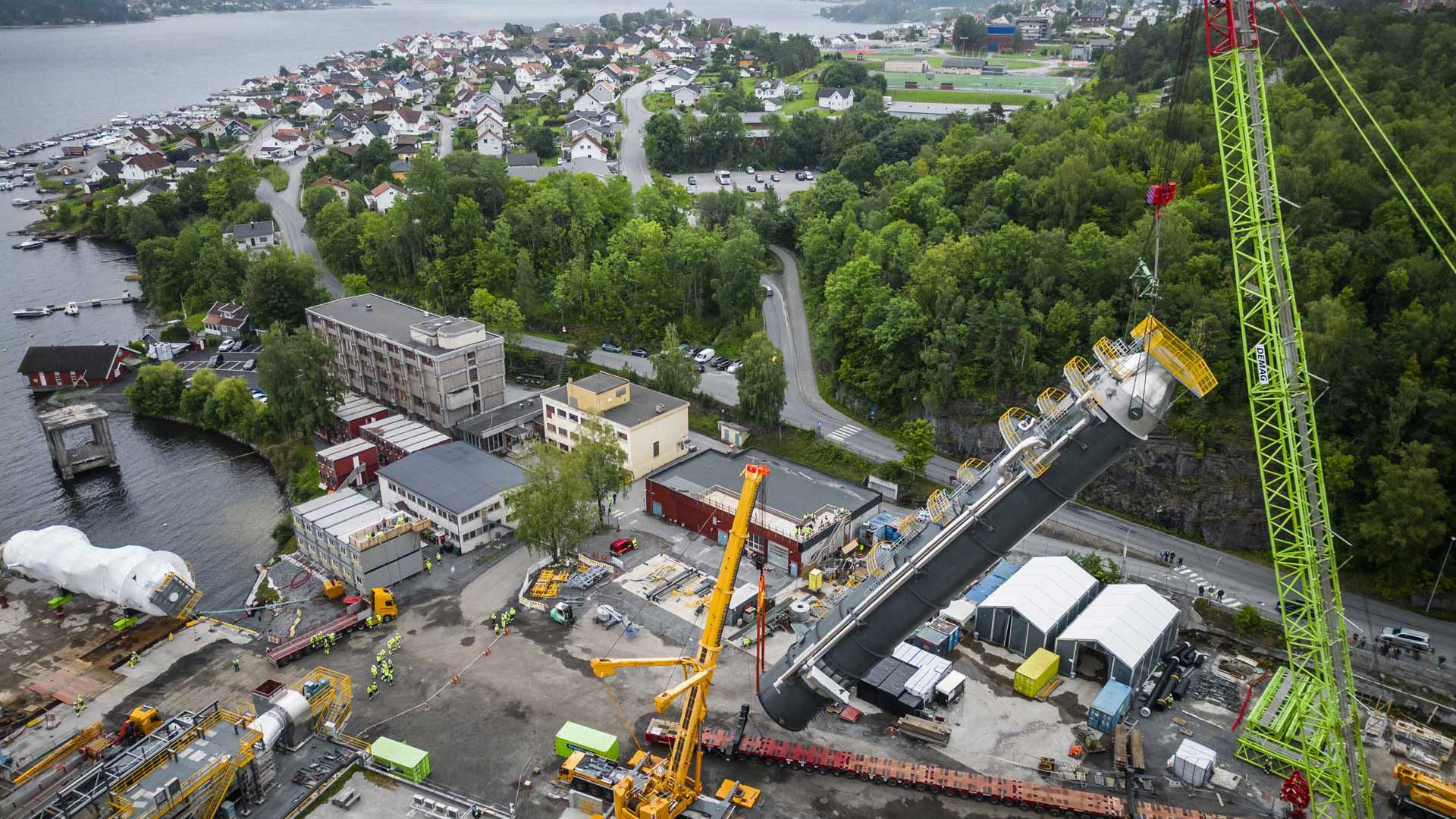
Brevik Cement Plant, Norway
PIONEERING CCS IN BREVIK, NORWAY
In Brevik, Norway, Heidelberg Materials has delivered what many in the sector long considered aspirational: an industrial-scale carbon capture facility integrated into a cement plant. The Brevik CCS project is widely regarded as a milestone, not just for the company, but also for heavy industry more broadly. It links into Norway’s wider carbon transport and storage infrastructure, forming part of the government’s Longship value chain.
On site, the company uses an amine-based post-combustion capture technology which absorbs CO2 before being stripped, compressed, and shipped to the Northern Lights storage facility, a consortium by Equinor, Shell, and TotalEnergies. Brevik CCS has the capability to capture 400,000 metric tons of CO2 per year – half of the plant’s total emissions.
The significance of Brevik lies not only in its technical achievement but also in its role as a lighthouse project. It demonstrates that industrial-scale carbon capture is viable and, importantly, that it can be deployed within existing operations. That combination of retrofit capability and scalability is key for an industry with vast installed assets.
Speaking at the formal opening event in June 2025, Dr. Dominik von Achten, Chairman of the Managing Board of Heidelberg Materials, underlined the importance of the moment: “Today marks a historic milestone and tectonic shift in the building industry. The opening of Brevik CCS is a tremendous technological achievement that will serve as a blueprint for entire industries as we progress towards Net Zero and into a new era of sustainable construction. Above all, it is a testament to what can be accomplished when exceptional minds with a shared vision and strong determination come together. I am very proud of our teams and the partners who have contributed to the success of this project.”
The project has attracted global attention, with industry stakeholders visiting the site to understand its design and implementation. Brevik CCS is widely regarded as a pioneering project, representing not only a highly advanced technical installation but also as a tangible example of industrial leadership on climate issues.
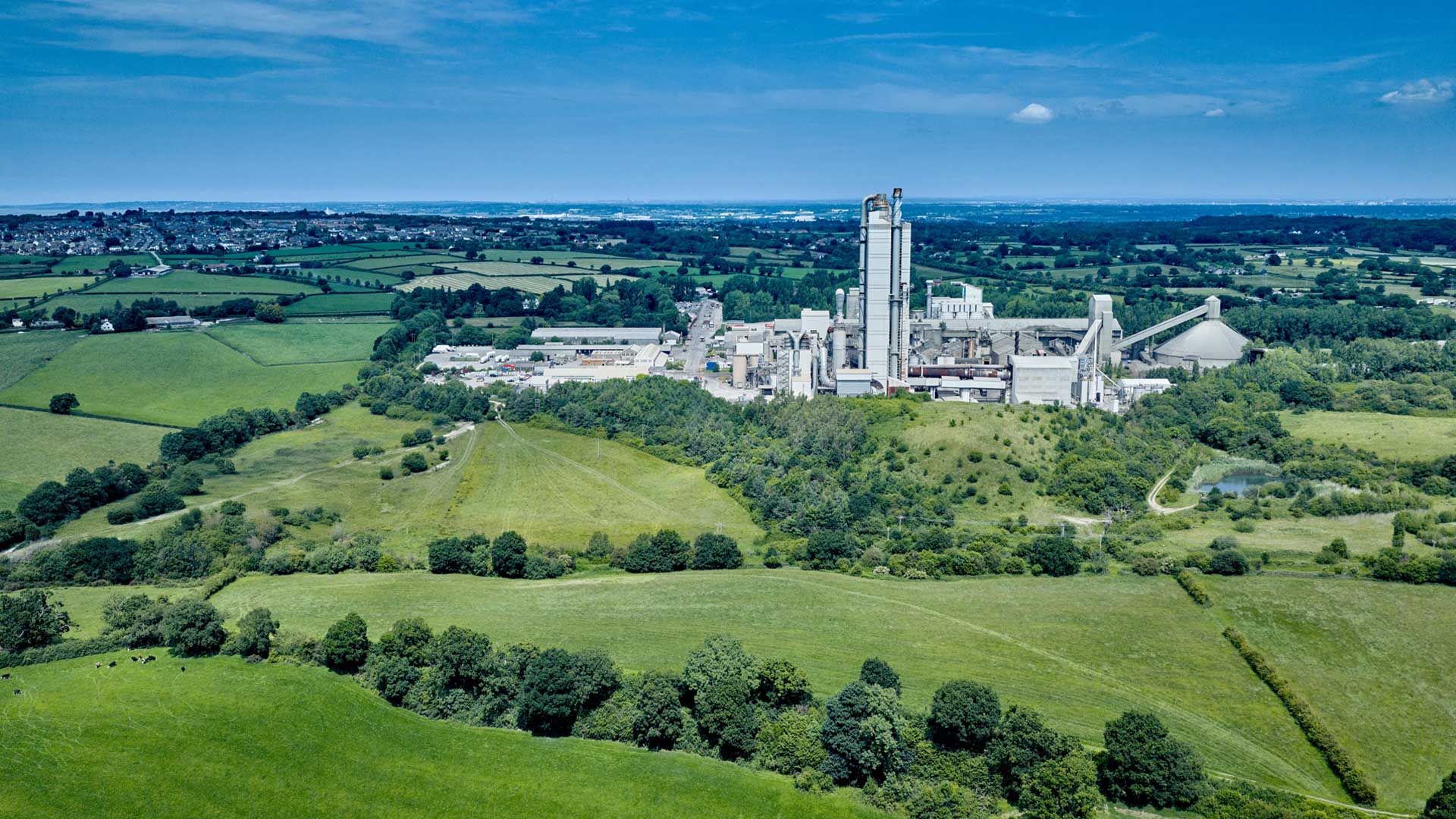
Padeswood Cement Plant, UK
UK MOMENTUM: SCALING CCS AT PADESWOOD
Building on the experience gained in Norway, Heidelberg Materials is advancing its second major CCS project in Padeswood, UK. Located within the emerging HyNet industrial cluster, the project reflects a growing recognition that decarbonisation must happen at a system level, with shared infrastructure enabling multiple emitters to capture and store CO2 efficiently.
Padeswood represents a significant step forward, not only in scaling CCS deployment but also in integrating it into the UK’s broader industrial strategy. The project has reached Final Investment Decision (FID) in 2025, signalling Heidelberg Materials’ confidence in both the technology and the policy framework supporting it.
With Padeswood, Heidelberg Materials will be able to significantly expand its offering of evoZero, the world’s first carbon captured near zero cement, enabling ambitious sustainable construction projects with measurable and verifiable CO₂ reductions and further accelerating the decarbonisation of the built environment.
Importantly, Padeswood is not a standalone initiative but part of the group’s deliberate learning curve. Insights from Brevik are being directly applied, accelerating development timelines and reducing risk. At Padeswood, Heidelberg Materials benefits from an invaluable advantage: The company is building on the knowledge and learnings developed at Brevik – with the teams behind its success sharing best practices with their UK colleagues.
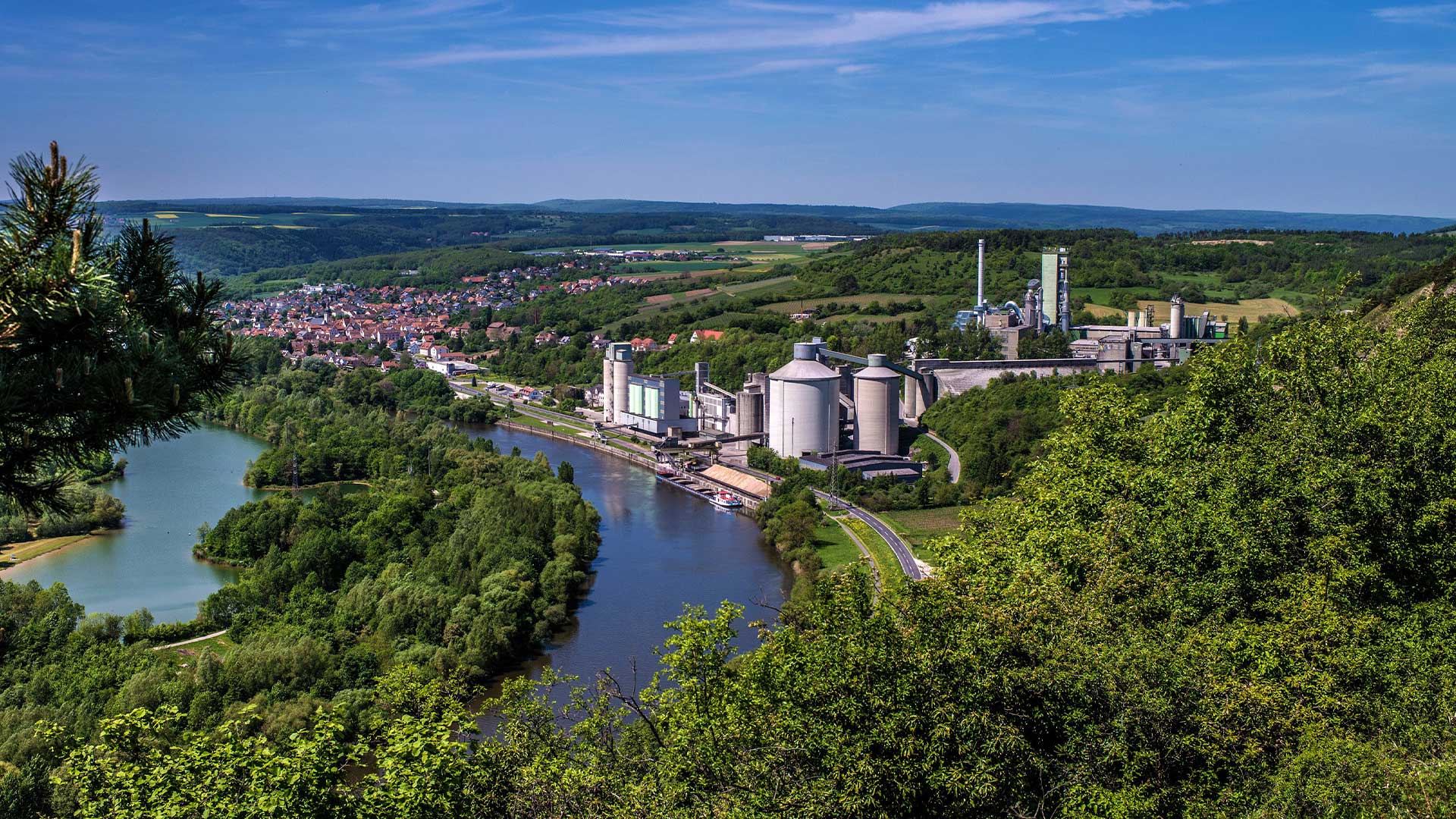
Lengfurt Plant, Germany
GERMANY – TURNING CAPTURED CO2 INTO VALUE
In Germany, Heidelberg Materials is pushing the boundaries of carbon capture utilisation (CCU) as well as storage. Its Lengfurt project – developed in partnership with Linde, starting operations in 2026 – is set to become the world’s first large-scale CCU facility in the cement industry, converting captured CO2 into valuable products such as food-grade carbon dioxide.
This approach adds an additional dimension to the CCUS value chain, demonstrating that captured emissions can become a resource rather than simply a liability. It also opens new revenue streams, potentially helping to improve the economics of carbon capture projects and accelerating their adoption.
Supporting the project with a €15 million injection, the German Federal Ministry for Economic Affairs and Climate Action (BMWK) sees the potential in capturing and enabling around 70,000 tonnes per year of purified and liquefied CO₂. Government funding and regulatory alignment are critical in de-risking early-stage projects, particularly in a sector where margins are tight and capital requirements are high.
Jan Theulen, Director CCUS Business Development & Partnerships at Heidelberg Materials: “We see Lengfurt as a strategic cornerstone in our global CCUS portfolio. Together with our partner Linde, we are demonstrating how captured CO2 can be transformed into a valuable resource at industrial scale. The BMWK funding underlines the significance the German government also attaches to our joint project, supporting the development and de-risking of the technology.” By aligning industrial ambition with public policy, projects like Lengfurt can move from concept to reality more quickly.
Taken together, these first-mover projects reflect Heidelberg Materials’ long-term commitment to CCUS. They have helped the company accumulate technical know-how, strengthen partnerships, and de-risk the pathways that underpin today’s large-scale implementations.
Rezzato Mazzano Plant, Italy
CREATING SUSTAINABLE SOLUTIONS IN ITALY
Beyond its headline CCUS deployments in Brevik, Padeswood, and Lengfurt, Heidelberg Materials has been building expertise and leadership in carbon capture technologies for years. A series of follow-up projects and pilot initiatives underscore how long the company has been preparing the ground for today’s industrial-scale roll-outs.
While Norway and the UK represent large-scale CCS deployment, Heidelberg Materials is also exploring several other complementary approaches. At its Rezzato-Mazzano site in Italy, the DREAM project – an acronym for “Decarbonisation of REzzato And Mazzano Cement Plant” – focuses on advancing carbon capture technologies in a different regulatory and industrial context.
Italy’s industrial landscape presents specific challenges, from permitting processes to infrastructure availability, but also offers a testbed for flexible, modular solutions that can be adapted to a variety of sites – including land-locked locations far from the coast. Rezzato-Mazzano is designed to connect into regional cluster activity, with captured emissions planned to be transported via pipeline to the coastal Ravenna CCS hub in the Adriatic Sea, where they will be stored in a depleted gas field.
The DREAM project, which has been awarded by the EU Innovation Fund, aims to capture around one million tonnes of CO₂ annually. It will combine a grey clinker line using oxy-combustion integrated with a cryogenic process and a white clinker line employing a solvent-based post-combustion system. Both will be paired with a special waste heat recovery unit to supply the thermal energy required for solvent regeneration, improving both energy efficiency and capture performance.
Importantly, such projects underline that the decarbonisation of cement cannot rely on a single blueprint. It requires a portfolio of solutions tailored to local conditions, supported by close collaboration between industry, government, and technology providers.
SHAPING THE NEXT WAVE OF CCUS
Next to Rezzato-Mazzano, Heidelberg Materials’ Antoing cement plant has been earmarked for a next-generation hybrid carbon capture installation. The Anthemis project, which has also gained EU Innovation Fund support, is based on an innovative oxyfuel carbon capture concept. Positioned between first- and second-generation oxyfuel technologies, the system is designed to strip out more than 95% of CO2 from the plant’s emissions once operational. By reducing structural complexity and resource intensity, the Antoing concept aims to improve the efficiency and cost-effectiveness of industrial capture solutions while providing a template for future retrofits across the network.
In France, the AirvaultGOCO₂ project – which has also won EU Innovation Fund support – stands out as another ambitious endeavour. Embedded within the GOCO₂ initiative to decarbonise industrial activity in western France, Airvault will integrate carbon capture with broader plant modernisation efforts. With a planned capture capacity of nearly one million tonnes of CO₂ annually, it will build on Heidelberg Materials’ experience and contribute to regional emission reduction goals while linking into wider transport and storage networks.
At Mergelstetten, Germany, pilot work by Heidelberg Materials together with three other cement producers on oxyfuel capture is helping to refine technologies that reduce CO₂ at source and inform larger projects elsewhere. These demonstrations have allowed engineers to test real-world performance and operational learnings long before full-scale deployment.
CHARTING THE PATHWAY TO NET ZERO
Heidelberg Materials’ strategy on CCUS is clear: develop, test, and scale solutions across different geographies, while building the partnerships and infrastructure needed for long-term deployment. Existing projects also reinforce the company’s view that carbon capture is not optional, but essential.
This perspective is increasingly shared across the industry. As global demand for low-carbon construction materials grows, producers that can demonstrate real emissions reductions are likely to gain a competitive edge. For Heidelberg Materials, this is already translating into product innovation.
The start of evoZero® deliveries in 2025 marked a significant milestone, with the world’s first carbon captured near-zero cement supplied to customers across Europe. Based on carbon capture and storage (CCS) at Heidelberg Materials’ Brevik plant in Norway, evoZero sets a new benchmark in the decarbonisation of construction. As Dr. Katharina Beumelburg, Chief Sustainability & New Technologies Officer of Heidelberg Materials stated at the start of the evoZero deployment: “With evoZero, Heidelberg Materials offers a new level of transparency and reliability in value chain decarbonisation. evoZero enables our partners and customers to turn their material choices into catalysts for sustainable action. This is how our comprehensive strategy – embracing established CO₂ reduction measures and leading the way in CCS – creates real impact.”
The implications of this exciting progress extend beyond the company itself. As customers seek to reduce their own carbon footprints, access to low-carbon materials becomes a critical enabler. Sergio Tortelli, Director Global Product Management for evoZero, reinforced this point: “For our customers, using this cement is not just about lowering emissions – it is a way to differentiate themselves and demonstrate clear leadership in the transition to CO₂‑reduced construction.”
Looking ahead, scaling CCUS will require much more than technological progress alone. While innovations such as evoZero demonstrate what is already possible, the broader deployment of carbon capture depends on a complex ecosystem of enabling factors. As Dr. Christian Preuss notes: “We have many projects in the pipeline, but they all need various pre-conditions to be successful. National funding programmes, EU regulations, sufficient infrastructure, and accelerated permitting are things that really matter when you want to drive future projects. Moving towards net zero in a hard-to-abate sector is anything but easy – many things need to come together.”
Chief among these is the need for robust economic frameworks, including carbon pricing mechanisms, co-funding and contracts for difference, to offset the high costs associated with CCUS and unlock investment at scale. At the same time, continued advances in capture, transport and storage technologies will be essential to improve efficiency and reduce costs, while parallel development of CO₂ infrastructure – from pipeline networks to secure geological storage – must keep pace with capture capacity.
Beyond engineering and economics, public acceptance and transparent engagement will play a defining role, particularly as projects expand across regions and communities. Ultimately, the transition will depend on coordinated action across sectors and borders, linking emitters with shared transport and storage systems. For the company, the journey of industrial decarbonisation at scale is achievable but requires alignment between policy, technology, infrastructure, and society.
As the cement sector confronts the realities of decarbonisation, Heidelberg Materials’ approach offers a clear message: progress depends on action at scale. By advancing multiple CCUS projects simultaneously, the company is not only reducing its own emissions but also helping to define the pathway for an entire industry.